How to Build a High-Performance Website That Actually Grows: The Engineering Playbook for SEO, Speed & Conversion
Written by Kok Hong published on Aug 1, 2026
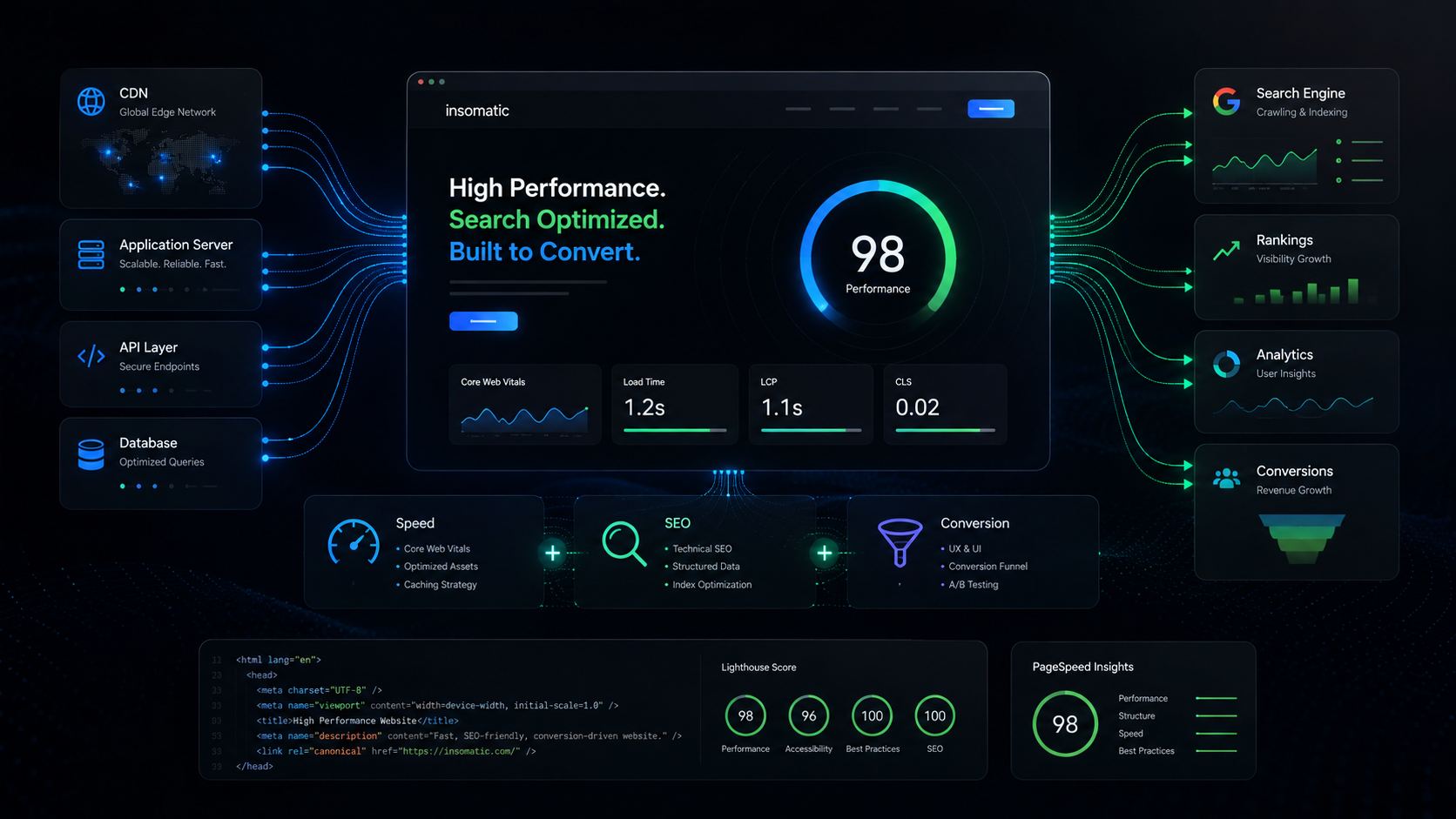
A website can look beautiful, rank well, and still fail to generate meaningful business results because growth is not just a marketing problem; it is an engineering problem. Page speed affects conversion, architecture affects SEO, content rendering impacts search visibility, and poorly designed APIs can slow down critical pages. Furthermore, third-party scripts damage Core Web Vitals, and a rigid CMS can bottleneck the marketing team. A high-performance digital platform needs to bring all these pieces together. This is a practical engineering playbook for building websites that are fast, crawlable, scalable, measurable, and designed to convert.
1. Start With Business Goals, Not Technology
Before choosing React, Next.js, a headless CMS, or a cloud provider, define what the website needs to accomplish. Typical objectives include generating qualified leads, increasing organic traffic, improving conversion rates, supporting thousands of content pages, selling products or services, integrating with CRM and marketing systems, allowing non-technical teams to publish content, supporting international markets, and reducing operating costs. Technology should support these goals. A technically impressive architecture that does not improve the business is not a successful architecture.
2. Architecture Is Part of Technical SEO
Search engines need to discover, crawl, render, and understand your content, meaning application architecture directly influences SEO. For content-heavy websites, server-side rendering or static generation can provide significant advantages over relying entirely on client-side rendering. A simplified architecture might look like this:
User
|
CDN
|
Web Application
|
+-------------------+
| CMS |
| APIs |
| Search |
| Database |
+-------------------+
The important thing is not whether a website uses a particular framework, but whether search engines can reliably access content, render pages efficiently, generate canonical URLs, control metadata, crawl internal links, cache pages, and publish new content without developer intervention.
3. Make Important Pages Fast by Default
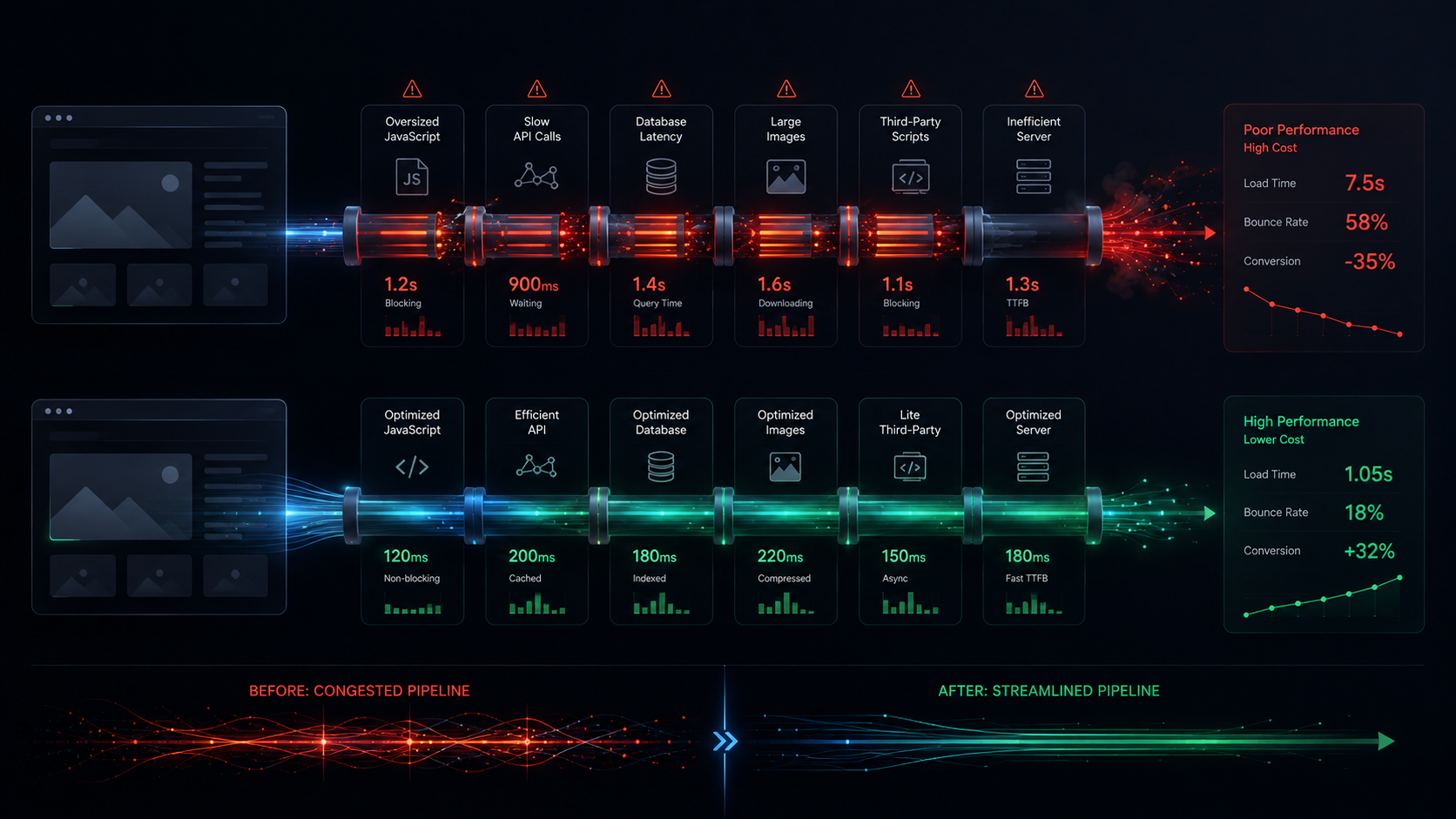
Performance optimization should never be an emergency project performed after launch; it must be part of the core architecture. Common performance bottlenecks include large JavaScript bundles, unoptimized images, slow database queries, excessive API calls, third-party tracking scripts, render-blocking resources, poor caching, slow server response times, and inefficiently loaded web fonts. The solution is usually a chain of small architectural decisions rather than one fix. For example:
Browser
|
CDN Cache
|
Application Cache
|
API
|
Database
If the same content is requested thousands of times, there is little reason to execute identical expensive database queries repeatedly. Proper caching can turn an expensive operation into a fast lookup.
4. Treat Core Web Vitals as Engineering Metrics
Core Web Vitals should not be treated as an SEO team’s responsibility alone, as developers influence them directly.
Largest Contentful Paint (LCP)
LCP measures how quickly the main content becomes visible. Potential problems include slow server response, large hero images, render-blocking CSS, slow fonts, and client-side rendering delays.
Interaction to Next Paint (INP)
INP reflects how responsive a website feels when users interact with it. Large JavaScript bundles and expensive event handlers can make otherwise attractive websites feel sluggish.
Cumulative Layout Shift (CLS)
CLS measures unexpected movement of content. Images without dimensions, dynamically injected content, advertisements, and poorly handled fonts are common causes. Performance means designing applications so expensive work happens in the right place at the right time.
5. Optimize Images Before Optimizing Everything Else
Images are frequently responsible for a significant percentage of a page’s weight. A production website should utilize modern image formats, responsive image sizes, lazy loading, proper dimensions, CDN delivery, compression, appropriate quality settings, and preloading only genuinely critical images. Do not send a 2,000-pixel image to a device displaying it at 400 pixels; the browser should receive approximately what it needs.
6. Build SEO Into the Content Model
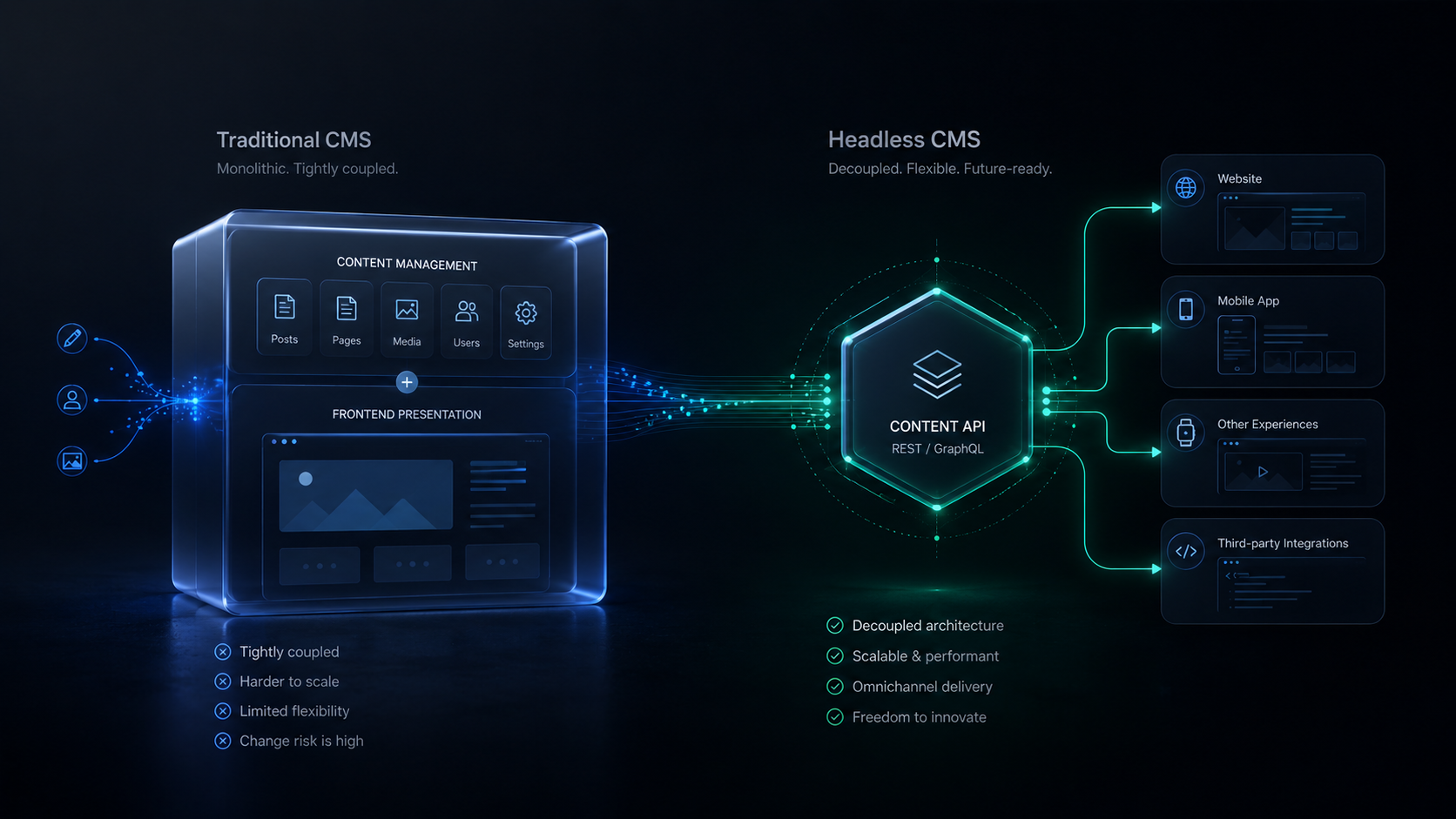
SEO should not depend on developers manually editing every page. A CMS should expose the core information marketers need:
Page
├── Title
├── Meta description
├── Canonical URL
├── Heading structure
├── Open Graph data
├── Structured data
├── Indexing preference
├── Related content
└── Internal links
This creates a system where SEO becomes part of publishing rather than a separate technical exercise.
7. Internal Linking Can Be an Engineering Feature
Internal linking is often treated as a manual editorial task, but for large websites, it can also be partially systematized. Content can be associated with topics, products, locations, services, industries, and related articles, allowing the application to automatically surface relevant content. This creates a network:
Pillar Page
|
+-- Supporting Article
|
+-- Supporting Article
|
+-- Product Page
|
+-- Case Study
The result is better navigation for users and a stronger information architecture for search engines.
8. Conversion Optimization Starts With Good Engineering
A fast website that does not convert is still a poor business asset. Conversion optimization involves faster forms, better validation, progressive disclosure, clear calls to action, reduced checkout friction, personalization, A/B testing, analytics, and CRM integration. The engineering team should make experimentation easy by building reusable components and a flexible content model rather than rebuilding landing pages manually every time marketing wants to test something.
9. Measure the Entire Funnel
Traffic is not the final metric. A useful measurement architecture connects organic search, landing pages, engagement, leads or purchases, CRM systems, and revenue. This makes it possible to answer critical questions such as which pages generate leads, which organic keywords generate revenue, which landing pages convert best, which traffic sources produce high-value customers, and which technical improvements correlate with better conversion. Without this data, optimization becomes guesswork.
10. Build for Growth From Day One
A growth-ready website should make it easy to add new pages and markets, publish content, run experiments, change landing pages, integrate new services, improve performance, analyze user behavior, and scale infrastructure. The goal is not to predict the future perfectly, but to avoid building an architecture that makes future growth unnecessarily expensive.
Conclusion
The best growth websites are not assembled by putting an SEO strategy, a design system, and a development team next to each other; they are engineered as one system. SEO determines whether people can discover the website, performance determines whether they can use it, UX determines whether they understand it, and conversion architecture determines whether they act. If growth is a core objective, performance, SEO, analytics, content, and conversion should be considered architectural concerns from the beginning rather than fixes added after launch.